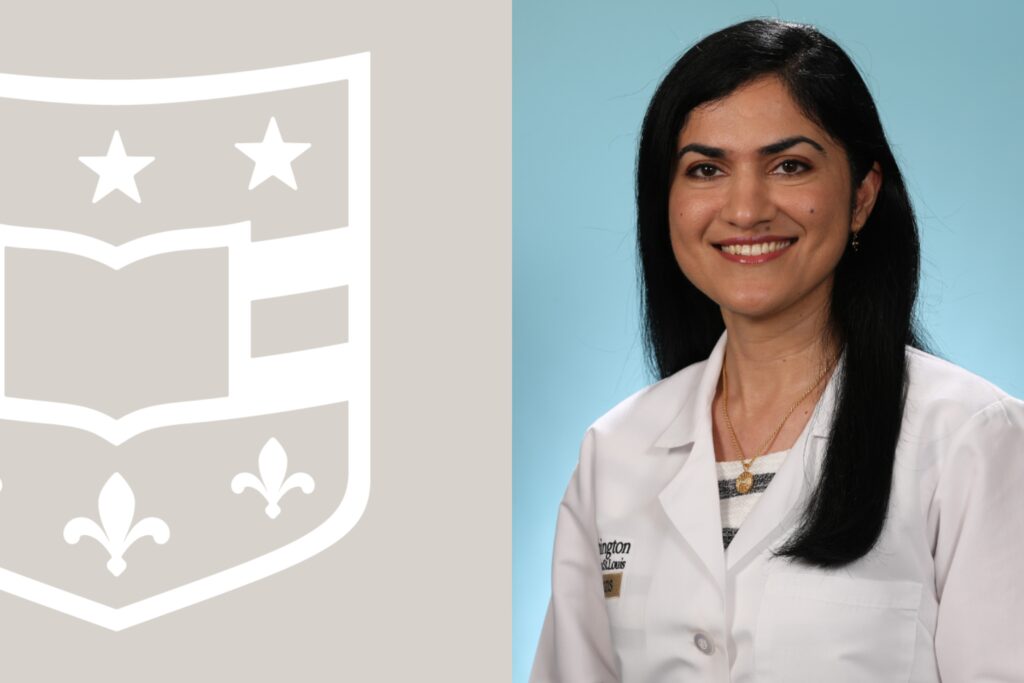
Roheena Panni, MD, MPHS, an assistant professor of surgery in the Section of Surgical Oncology, was recently named a 2025 Dean’s Scholar at Washington University School of Medicine.
In this interview, originally published by the Division of Physician-Scientists, she describes her research, motivations and the importance of mentorship.
What motivated you to become a physician-scientist?
I chose surgery because it allowed me to be directly involved in patient care, particularly for those with aggressive cancers where treatment options are often limited. The immediate impact of operating was deeply satisfying, but over time I began to recognize its limitations, especially in diseases like pancreatic cancer where long-term outcomes remain poor despite successful surgical resections. That realization led to a deeper sense of responsibility, not only toward the individual patient in front of me but also toward the broader mission of advancing more effective treatment options. This inspired me to pursue clinical and translational research focusing on pancreatic cancer, a field where progress has been slower than in other areas others. As a surgeon-scientist, I work at the intersection of the operating room and the laboratory where clinical care and research mutually inform each other. It is this blend of patient care and discovery that drives me every day. I aim for my work to have not only an immediate impact in the operating room but also a lasting influence through innovation and better outcomes.
What drew you to surgical oncology and hepatobiliary surgery?
Surgical oncology, especially hepatopancreatobiliary (HPB) surgery, drew my interest because of the complexity of these diseases, the high stakes involved, and the need for multidisciplinary collaboration. Cancers of the liver, pancreas, and bile ducts are among the most challenging, both surgically and biologically. They’re often diagnosed late, and surgical resection remains the only chance for cure in many cases. What solidified my commitment to this field was recognizing that meaningful improvement in patient outcomes requires both clinical care and research. Whether by refining surgical techniques, identifying biomarkers to guide treatment, or developing more effective therapies, there remains a substantial need for progress. This dual role provides a way to contribute that remains closely connected to patients’ needs.
Tell us about your research.
My research is focused on developing new immunotherapeutic strategies for pancreatic cancer, with a particular emphasis on improving T cell function. Pancreatic cancer remains one of the most treatment-resistant solid tumors. Unlike other cancers where immunotherapies have shown transformative results, pancreatic cancer has largely remained unresponsive to current immunotherapeutic approaches. To address this challenge, we are investigating personalized neoantigen vaccination as a strategy to overcome the immunosuppressive tumor microenvironment and intrinsic resistance mechanisms characteristic of pancreatic cancer. This precision-based approach involves comprehensive identification of tumor-specific mutations that are uniquely expressed by an individual’s tumor cells. Leveraging this information, we develop customized vaccines intended to prime and expand neoantigen-specific T cell responses, thereby directing the immune system to selectively recognize and eliminate malignant cells harboring these neoantigens. This personalized immunotherapy aims not only to overcome dominant mechanisms of immune evasion in pancreatic cancer but also to provide lasting clinical benefits. Ultimately, our goal is to develop treatments that prolong survival while maintaining and ideally enhancing quality of life for patients facing this devastating disease.
Mentorship has been foundational to my journey as a surgeon-scientist.
Mentorship has been central to my path as a surgeon-scientist. Early on, I had the privilege of learning from individuals like Drs. David Linehan, William Hawkins, and Ryan Fields, who not only excelled in surgery but also led influential research programs. Watching them navigate both fields with purpose and integrity inspired me to pursue a career that connects the operating room and the lab. I’m deeply grateful to be surrounded by generous and supportive clinical and research mentors. Dr. David DeNardo, Ph.D., has played a pivotal role in my scientific training during residency and in helping me navigate the early stages of my career as a surgeon-scientist. I’ve also learned a great deal from surgeon-scientists like Dr. William Gillanders. Additionally, I have benefited immensely from the continued mentorship and support of leaders in the department of surgery, Drs. John Olson and Tim Eberlein. Their mentorship has been more than guidance; it has shaped how I think, how I lead, and the kind of colleague and mentor I aspire to be. I truly wouldn’t be where I am today without the support of my mentors, and I carry their example with deep gratitude as I move forward.