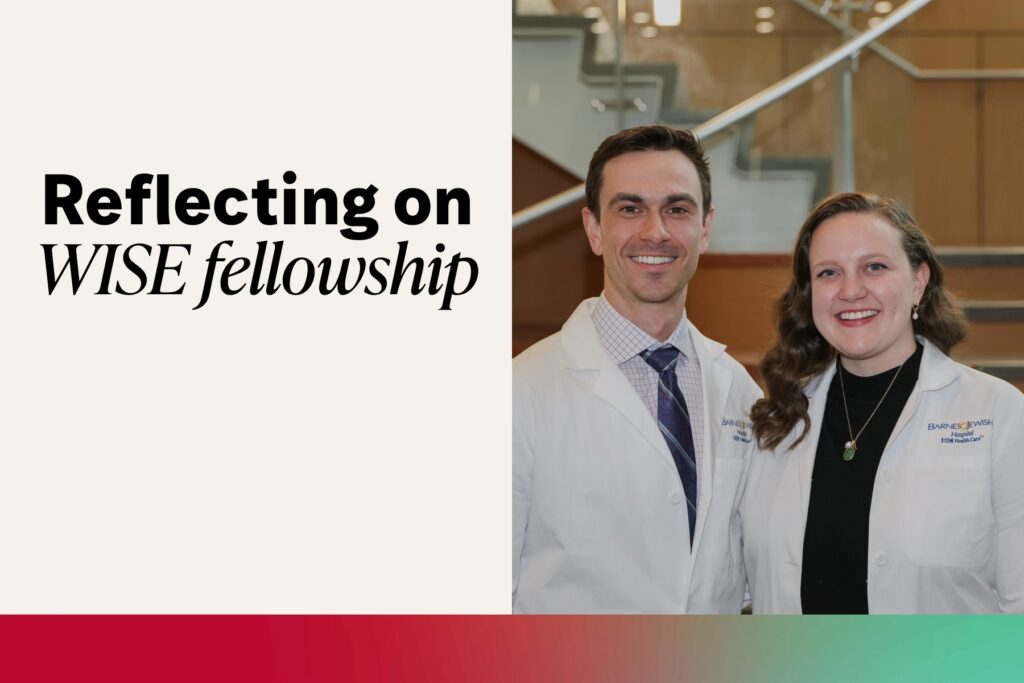
As they prepare to return to full-time clinical training, Blake Beneville, MD, MPHE, and Abby Hatcher, MD, MSc, are leaving a lasting mark on surgical education at Washington University School of Medicine. Over the past two years, the general surgery residents have served as the American College of Surgeons – Accredited Education Institutes (ACS-AEI) Simulation and Education Fellows, a unique role that allowed them to shape curriculum, lead innovative research projects and develop the leadership skills that will influence their future careers in academic surgery.
The fellowship is available at fewer than 20 accredited institutions and was established to improve the quality of surgical care by developing future leaders and scholars in the areas of surgical education, simulation and training.
Converging paths
For both fellows, the path to surgery began long before medical school. Beneville discovered his passion through early exposure to the operating room and surgical departments during high school and college.
“It was all these little things that just kept engaging me with surgery and people in that world,” Beneville said. “Nothing else struck my fancy quite like that.”
Hatcher’s interest emerged at age 14 after shadowing a surgeon.
“I thought it was the coolest thing ever,” Hatcher said. “I’ve always liked solving puzzles and fixing things, and I liked the immediacy of solving a problem and seeing a patient through that way.”
Her background in health education further strengthens her commitment to a career that combined patient care, teaching, and mentorship.
The ACS-AEI Simulation and Education Fellowship provided a structured environment for both residents to explore those interests while serving as leaders within the general surgery residency program in the Department of Surgery. Through the fellowship, they collaborated with residency leadership, simulation experts, faculty and trainees across every surgical specialty both within the institution and nationally.
“The fellowship itself has been a really amazing opportunity,” said Hatcher. “It challenged us in a good way. It made us step up and say, ‘Okay, we are leaders in this program. Let’s contribute our strengths and our ideas.’”
Beneville agreed, noting his expectations were dwarfed by the wealth of experience available through the fellowship.
“I never would have expected the depth and breadth of responsibilities and opportunities that we would have,” Beneville said. “Every fellow before us has focused on something different. The fellowship gives you the flexibility to make it your own. The fellowship provided just that bare structure that I needed to build on and take it where we wanted it to go.”
One of the fellows’ most significant accomplishments was a comprehensive assessment and redesign of the residency education curriculum. Through focus groups, surveys and resident feedback, they evaluated existing educational structures and implemented improvements to didactic programming, simulation experiences and rotational learning opportunities.
The pair also became central connectors within the surgical education community, linking students, residents, faculty, and collaborators with projects and mentorship opportunities.
“The role made us a touchpoint for people, for anything surgical education related,” said Hatcher.
Protected research time
The fellowship is housed primarily in the Washington University Institute for Surgical Education (WISE), located in the Clinical Sciences Research Building.
Established in 2018, the fellowship was led by Michael Awad, MD, PhD, MHPE, who served as director of WISE, from its inception. As the primary mentor for the simulation fellowship, Awad helped to flesh out the WISE curriculum over the past 15 years. He will be transitioning out of WISE leadership to a serve as vice chair for education at Stanford University in September.
Beginning in the new academic year, the fellowship and WISE will be led by Paul Wise, MD, vice chair for education in the Department of Surgery.
Their research efforts reflected the same spirit of innovation. Beneville focused on educational technology, feedback and autonomy in surgical training. His grant-funded research explores how emerging technologies, including artificial intelligence, can capture and summarize educational interactions that occur during surgical procedures.
“There’s so much rich dialogue that happens in the operating room—feedback, coaching, teaching, life advice,” Beneville explained. “We began exploring what would happen if we could capture that and use the technology available to help summarize it into educational reports for trainees.”
Hatcher’s research centered on curricular assessment, feedback systems, simulation and colorectal surgery education. Together, the fellows led one of their most impactful projects: developing a comprehensive emergency robotic undocking curriculum. The initiative trains residents to safely remove robotic systems during surgical emergencies, such as major hemorrhage or patient instability.
The project included baseline assessments, educational interventions, follow-up evaluations and the production of a professional instructional video. The work was recognized as a best poster in its category at WashU Medicine’s 2026 Samuel A. Wells, Jr. Department of Surgery Resident Research Day competition and is currently being prepared for publication.
Rewarding experience
While awards and publications were gratifying, both fellows found the greatest reward in hearing how the training affected patient care.
“The best thing is to hear that our training actually had an impact,” said Hatcher. “Residents have told us that when emergency scenarios occurred in the operating room, they felt comfortable, they knew what to do and they were able to help guide the team responding to the emergency.”
“Education research often asks how we can show an impact on patient outcomes,” said Beneville. “In those moments, it felt like we were able to do that.”
Beyond research accomplishments, the fellowship helped both residents develop essential skills for a career in academic surgery. Leading committees, managing projects, facilitating meetings and collaborating with multidisciplinary teams prepared them for future leadership roles in surgery.
“The lessons learned go far beyond research,” Hatcher said. “Learning how to be a leader and a collaborator in the education space, gaining the experience to lead a project and solve problems—that’s what I’ll take away the most.”
For Beneville, the experience expanded his understanding of what an academic surgical career can look like.
“This wasn’t just research time,” he said. “It was professional development time. We learned skills that are transferable to whatever we do in the future, and it gave me confidence in stepping into future leadership roles.”
The program faculty and mentors emphasize the value of pursuing this fellowship during residency.
“It’s clear that both Blake and Abby have benefitted professionally and educationally from the fellowship,” Awad said. “But they have clearly made remarkable contributions to our surgical education program during their time as fellows.”
On the horizon
As they return to clinical residency training, both fellows are excited to apply what they have learned as educators and mentors to the next generation of trainees. Looking further ahead, both have expressed an interest in colorectal surgery, while remaining open to the many opportunities available across surgical subspecialties.
The fellowship has also strengthened their commitment to academic surgery, where they hope to combine clinical excellence with education, mentorship and innovation.
“I’m excited for the day when I get to do both,” Hatcher said. “To take care of patients and also contribute to education and curriculum development.”
“We’re looking forward to taking these experiences into fellowship and into practice, and continuing to build on what we started here,” said Beneville.
WISE ACS-AEI Simulation and Education Fellowship
For Beneville and Hatcher, that flexibility became the foundation for two years of growth, innovation and leadership—an experience that will continue shaping their careers and the future of surgical education for years to come.
For residents with an interest in teaching, mentorship, curriculum development, simulation, or educational research, Beneville and Hatcher strongly encourage exploring the ACS-AEI Simulation and Education Fellowship.
Throughout their experience, the fellowship provided far more than protected research time—it offered structured mentorship, national networking opportunities, leadership development, and hands-on experience shaping surgical education at both the local and national levels. They emphasize that the program allowed them to grow as collaborators, project leaders and innovators while building skills directly applicable to future careers in academic surgery.
For residents seeking to expand their impact beyond the operating room and help shape the future of surgical training, the fellowship represents an exceptional opportunity for professional growth and lasting influence. Additionally, the Department of Surgery is currently in the early stages of developing the Surgeon-Educator Training Program, a forthcoming component of the Surgeon-Scientist Training Program, for which the simulation fellowship has set the groundwork.