The Division of Physician-Scientists at WashU Medicine is dedicated to cultivating the next generation of investigators who bridge scientific discovery with exceptional patient care. Through mentorship, protected research time and career development opportunities, the division supports faculty and trainees pursuing careers that unite clinical medicine and biomedical research.
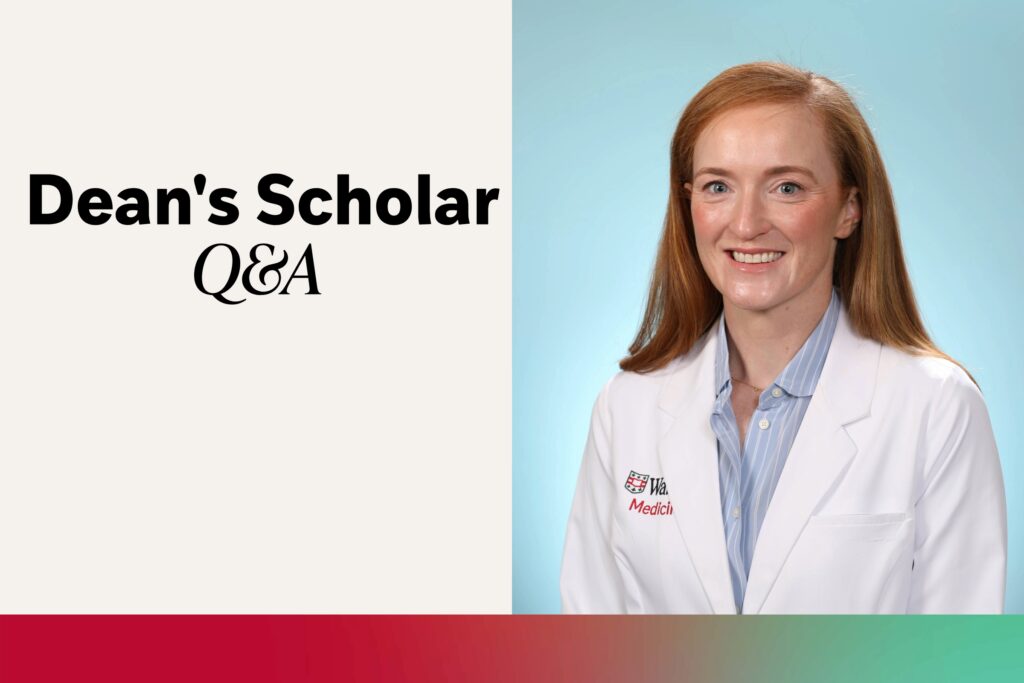
As part of its July 2026 newsletter, the Division of Physician-Scientists highlighted newly named Dean’s Scholars, recognizing early-career faculty whose research has the potential to advance medicine through innovative, translational science. Among those featured is Ruth Tevlin, MD, assistant professor of surgery in the Division of Plastic and Reconstructive Surgery, whose work seeks to improve outcomes for children undergoing complex craniofacial reconstruction.
A pediatric craniofacial plastic surgeon, Tevlin specializes in the care of children born with congenital craniofacial differences and others requiring complex craniofacial reconstruction. As a surgeon-scientist, she combines clinical expertise with laboratory investigation to better understand how craniofacial bones heal, grow and regenerate. Her research focuses on the biology of bone regeneration, with the goal of translating scientific discoveries into more predictable and effective reconstructive treatments for pediatric and adult patients.
The Dean’s Scholar program provides promising physician-scientists with protected research time, mentorship and institutional support during a pivotal stage of their careers. For Tevlin, the recognition reflects both WashU Medicine’s investment in surgeon-scientists and the opportunity to build a research program directly informed by the needs of children with craniofacial conditions.
Tevlin Q&A
Question: What motivated you to become a physician-scientist?
Tevlin: I was drawn to medicine because of the opportunity to care for patients and families at pivotal moments in their lives. My path toward becoming a physician-scientist began during a research fellowship in Dr. Michael Longaker’s lab, where I first saw how fundamental biology could be connected directly to surgical problems. That experience changed the trajectory of my career and opened my eyes to the power of asking scientific questions that emerge from patient care.
During my training, I became aware that many questions we face in the operating room do not yet have satisfying biological answers. Why do some children heal and grow wonderfully after craniofacial reconstruction while others have more variable outcomes? How do mechanical forces and developing tissues shape bone healing? Becoming a physician-scientist felt like the best way to connect questions from patient care with laboratory approaches that can move discoveries from bench to bedside and improve patients’ lives.
Q: What drew you to your field?
T: I was drawn to craniofacial surgery because it brings together anatomy, development, growth, function and aesthetics in a uniquely compelling way. The face is how we communicate with the world—how we express emotion, identity and connection—and it is a tremendous privilege to operate on a patient’s face. Pediatric craniofacial surgery is also about more than repairing a structure at one moment in time; because children are still growing, the goal is often to guide future growth and development.
I am also inspired by the history of craniofacial surgery as a relatively young field. Surgeons such as Paul Tessier were willing to challenge convention and create an entirely new specialty. That spirit of creativity, technical courage and respect for biology drew me to the field. Most of all, I am motivated by my patients and families, whose bravery and trust continually remind me why this work matters.
Q: Tell us about your research.
T: My research focuses on craniofacial bone regeneration, particularly how mechanical forces regulate skeletal healing and growth. Clinically, cranial vault distraction osteogenesis is used to expand the skull in children with complex craniosynostosis, but how new bone forms in the cranial vault in response to distraction is unknown.
This matters because the cranial vault has a unique developmental and anatomic environment, including the dura, periosteum, cranial sutures and growing brain. My lab studies how mechanical strain is translated into bone regeneration across these craniofacial tissue interfaces.
The broader goal is to define the mechanobiologic programs that govern craniofacial skeletal repair and translate that knowledge into more predictable, biologically informed approaches for children and adults requiring craniofacial reconstruction.
Q: What has mentorship meant to you?
T: Mentorship has been one of the defining forces in my career. Dr. Michael Longaker gave me the chance of a lifetime when he offered me a research fellowship in his lab at Stanford University. That opportunity changed my life. It opened the door to academic surgery, showed me what was possible as a surgeon-scientist, and helped me imagine a path I had not fully seen for myself.
I was also deeply influenced by Dr. Charles ‘Chuck’ Chan, who taught me to be brave in science—to ask hard questions, pursue ambitious experiments and bring creativity and joy to discovery.
My mentors from plastic surgery residency at Stanford and craniofacial surgery fellowship at Seattle Children’s continue to make themselves available to me at this early stage of my career, and I am deeply grateful for that ongoing support. As I build my own career, I hope to pay that forward by offering trainees the same opportunity, belief, courage and guidance my mentors gave me.
Q: What does it mean to be a Dean’s Scholar?
Being a Dean’s Scholar is both an honor and a responsibility. It provides protected time, mentorship and institutional support at a critical stage in my development as a surgeon-scientist. More importantly, it reflects WashU’s commitment to building the next generation of investigators who can bridge patient care and discovery.
For me, it represents the opportunity to develop a research program directly informed by the needs of children with craniofacial conditions and aimed at improving the care we provide.
Q: Three things about me
T: Outside the hospital and laboratory, Tevlin enjoys spending time with her family, painting with her children and exploring the outdoors. Originally from Ireland, she values time with family and says few things feel more like home than sharing a cup of tea in her parents’ kitchen in Dublin or with her in-laws in Limerick. Since joining WashU Medicine, she and her family have enjoyed discovering the many attractions of Forest Park.
Advancing discovery through surgeon-scientists
Tevlin’s work exemplifies the mission of WashU Medicine’s Division of Physician-Scientists: empowering clinician-investigators to translate observations from patient care into scientific discoveries that improve health. Through initiatives such as the Dean’s Scholar program, the division is strengthening the pipeline of physician-scientists whose research will shape the future of medicine while advancing specialized patient care across WashU Medicine.