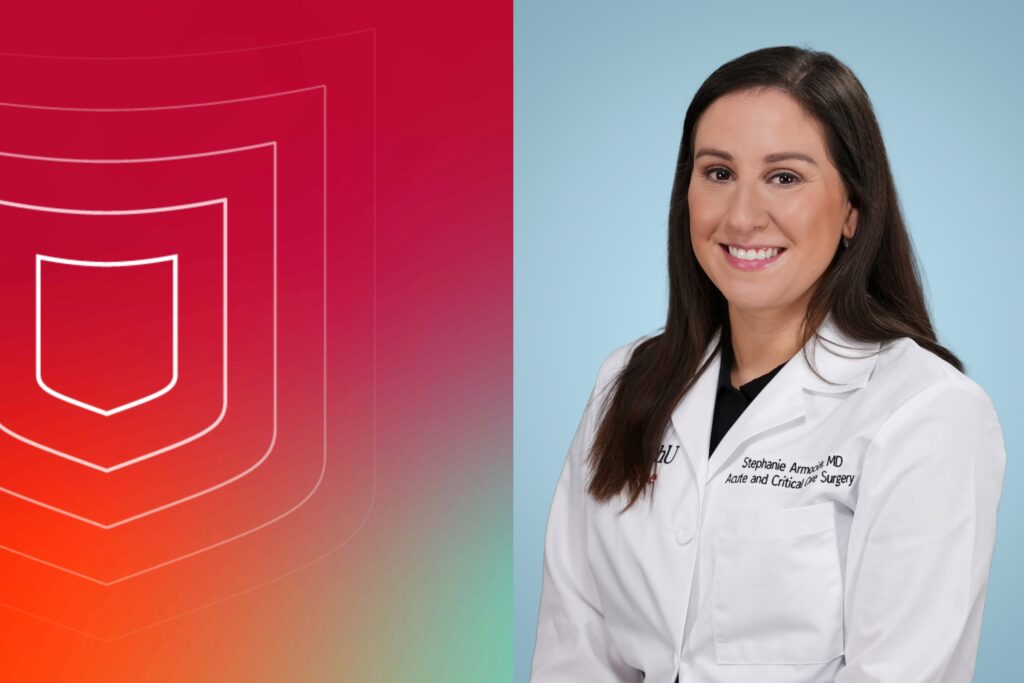
Stephanie Armocida, MD, is a 2nd year Acute Care Surgery fellow at WashU Medicine. After completing the fellowship later this summer, she will join the Department of Surgery as an assistant professor in the Section of Acute and Critical Care Surgery.
For Armocida, the path to acute and critical care surgery began during her surgical training, when she discovered a specialty that combined technical and medical complexity along with longitudinal patient care.
“The variety of cases and patients, the breadth of anatomy, and the fact that you get to follow patients through the continuum of care drew me to the field,” said Armocida. “Unlike many surgical specialties, acute care surgeons often care for patients from the moment they arrive to the hospital, provide critical care during their ICU stay, through recovery, and into discharge.”
WashU Medicine’s fellowship program offered an ideal environment to further develop those interests. After completing residency training at Sinai Hospital of Baltimore, Armocida sought an academic medical center where she could expand her involvement in surgical education, quality improvement initiatives, and trauma systems. She found all of those opportunities at WashU Medicine.
The Surgical Critical Care fellowship is one year with an option for a second year of Acute Care Surgery training. The fellowships provide broad clinical and professional development. During the first year of Surgical Critical Care training, fellows spend eight months rotating through multiple intensive care units, including trauma, cardiac surgery, surgical oncology, and community ICU settings. The second year of Acute Care Surgery training emphasizes operative and leadership experience, allowing fellows to function in an attending-like role on trauma and emergency general surgery services while continuing critical care training.
Armocida credits the program’s mentorship culture as one of its greatest strengths. In addition to a formal mentor program, she found guidance from faculty across disciplines, including surgery, anesthesiology, and emergency medicine.
“As big of a hospital as this is, within the department, it really starts to feel like home,” Armocida said. “There is no lack of support. If someone is sick or needs the schedule flipped around, there is never any hesitation for someone else to pick up shifts.”
Elective opportunities also helped shape her fellowship experience. She pursued specialized training in ultrasound, extracorporeal membrane oxygenation (ECMO), and clinical nutrition, while gaining unexpected expertise in conducting difficult conversations with patients and families about goals of care and end-of-life decision-making.
As a member of the fellowship’s first all-female surgical critical care class, Armocida valued the strong sense of camaraderie among fellows and the supportive culture that extends throughout the program.
“It was really cool to be a part of the first all-female fellowship class for surgical critical care at WashU,” says Armocida. “There were six of us. We came from all different parts of the country, all different walks of life. But that was one fact that kind of bonded us together.”
Looking ahead to her faculty role, Armocida is eager to continue caring for complex patients while teaching residents and medical students. The combination of clinical excellence, education, quality improvement, and collaborative culture made staying at WashU Medicine an easy decision.
“It’s hard to check all of those boxes at any one institution,” she said. “But WashU does.”