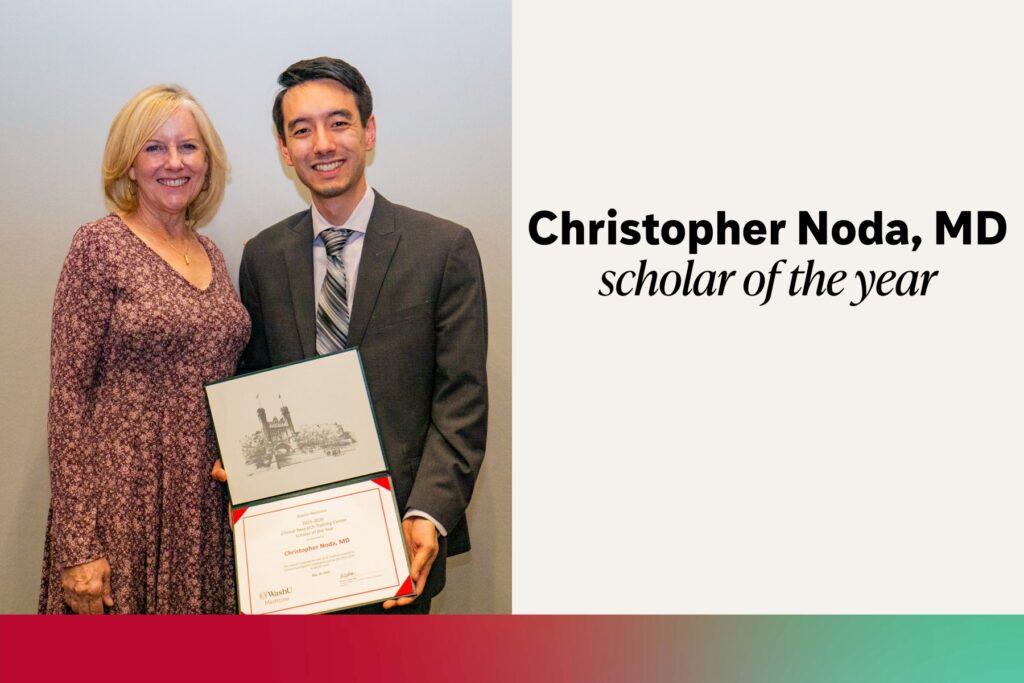
Christopher Noda, MD, was named scholar of the year by the Clinical Research Training Center at Washington University School of Medicine.
Noda is a research fellow in the TL1 program at the Institute of Clinical and Translational Sciences (ICTS) and a general surgery resident at Washington University School of Medicine.
The honor recognizes his emerging work at the intersection of clinical care, bioethics, and physician well-being. Awardees are chosen based on nominations from Clinical Research Training Center (CRTC) directors, course directors, and staff. The award was announced and presented at the CRTC Joint Recognition and Commencement Ceremony at the Eric P. Newman Education Center on Thursday, May 14.
This recognition continues to build on Noda’s recognition as an academic and clinical researcher. Noda also won the 2026 Ethics Committee Essay Challenge by the Association for Academic Surgery. The essay, coauthored by pediatric surgeon and associate professor of surgery, Kathryn Rowland, MD, MPHS, director of the Center for Humanism and Ethics in Surgical Specialties (CHESS), was a reflection on a powerful patient encounter during his time as a clinical resident and influenced by his research through the Division of Pediatric Surgery and CHESS at WashU Medicine.
Academic background
Noda was drawn to medicine because of the chance to build relationships with patients and make a significant impact on their lives, as he enjoyed and excelled in science throughout school and college. He describes his decision to pursue surgery as an ongoing process shaped by early exposure, evolving interests, and the influence of mentors.
“I grew up in the St. Louis area where my father was a surgeon,” Noda said. “He had a major influence and, now, is a major source of support.”
Noda completed undergraduate study at Colgate University before returning to St. Louis for medical school at WashU Medicine. He earned his medical degree in 2022 and entered the general surgery residency.
“I initially wanted to distinguish myself from my father, and thought I might want to pursue interventional radiology,” Noda said. “I was attracted by image-guided, minimally invasive procedures, but, I soon determined that the depth of patient encounters that I found most meaningful made surgery the right fit.”
He explained, “In surgery, you get to develop deep, close relationships with patients, building the level of trust needed to perform something really humbling and life-saving for them over a short period of time, making important decisions in the operating room.”
Through shadowing and early experiences in clinical medicine, Noda shifted his focus to surgery and now, on to academic research.
Research focus
His TL1 research focuses on how clinicians working with children and young adults who face serious or life-threatening illness can sustain virtue, practical wisdom and moral resilience in an era shaped by advanced technologies.
In one project, Noda is helping develop and apply a metric to better understand the well-being and resilience of pediatric and young adult oncology patients and survivors, with the goal of identifying where additional resources and support are needed—while also learning from those who demonstrate unexpectedly high resilience.
Noda is using the momentum gained from this latest recognition to advance his leadership within the TL1 program and the CRTC, to mentor the next generation of predoctoral medical students, and to refine how he communicates results and builds effective research teams. At the same time, he is thinking ahead to how AI could both help and hinder clinicians’ ethical practice, warning that overreliance on large language models risks eroding practical wisdom and patient trust.
“Receiving the CRTC Scholar of the Year award is an incredible honor and a powerful motivator,” Noda said.
Rather than serving as a finish line, recognition drives his daily efforts to become a better version of himself—through clearer communication of results, more effective teamwork, and a deeper sense of gratitude for the opportunity to make a meaningful impact on the scientific community.
Noda credits his mentors in his ongoing development as a physician and scholar, modeling their compassion, presence, and moral commitment at the bedside.
“Being surrounded by incredibly hardworking, humble individuals continues to motivate me on a daily basis,” said Noda. “It was the example of mentors—through the virtues they practice and the way they cared for their patients—that inspired me and continues to inspire me.”