The Kiran Mahajan Lab aims to characterize epigenetic regulators promoting survival, adaptability and metastasis of lethal cancers, particularly hormone refractory prostate cancers and characterize novel small molecule inhibitors that we have identified as having potent anti-tumor activity against metastatic prostate cancers.
The lab is led by Kiran Mahajan, PhD, MSc, an associate professor of surgery in the Division of Urology and chief of the Section of Surgical Therapeutics in the Division of Surgical Sciences at WashU Medicine.
The overarching goal of Dr. Kiran Mahajan’s research is to characterize epigenetic regulators promoting survival, adaptability and metastasis of lethal cancers, particularly hormone refractory prostate cancers and characterize novel small molecule inhibitors that we have identified as having potent anti-tumor activity against metastatic prostate cancers.
The laboratory is focused on characterizing the mechanism of action of lineage-specific transcription factors, particularly HOXB13, tyrosine kinases and novel non-coding RNAs as epigenetic regulators of disease specific targets. By identifying novel therapeutic vulnerabilities, the lab has uncovered epigenomic mechanisms driving plasticity of castration-resistant prostate cancers. The overall idea is to develop a robust pharmacogenomics pipeline to advance novel inhibitors as cancer therapeutics.
A second interest of the lab, which is integral to the existing interest in prostate cancer, is the epigenetic regulation of DNA damage signaling pathways. Based on the notion that genome instability drives tumor heterogeneity, clonal adaptation and drug resistance, and intact DNA repair pathways are critical to maintain the integrity of the genomes, the lab is characterizing novel regulators of genome stability and how these may be compromised as prostate cancer progresses to castration resistant stage.
Principal investigator

Kiran Mahajan, MSc, PhD
Associate Professor of Surgery
Chief, Section of Surgical Therapeutics
Division of Surgical Sciences
Division of Urologic Surgery
- Phone: 314-273-7728
Contact
PI Office:
Cancer Research Building, Room 5517
Campus Box 8242
660 S. Euclid Ave.
St. Louis, MO, 63110-1093
Lab Shipping Address:
Kiran Mahajan Lab
Cancer Research Building, Room 5513 and 5515
Campus Box 8242
660 S. Euclid Ave.
St. Louis, MO, 63110-1093
E-mail: [email protected]
Phone:
Office: 314-273-7728
Lab: 314-273-7760
Fax: 314-272-7771
Current research
Highlights
HOXB13, a homeodomain containing transcription factor, is linked to aggressive Prostate Cancer (PCs). However, to date its critical epigenetic regulators and effectors in PC metastasis remain largely unknown. We uncovered that the BET bromodomain protein family, including BRD4, is an epigenetic regulator of HOXB13. BRD4-HOXB13 inturn regulate unique mitotic transcriptional networks that is Androgen receptor independent and upregulated during metastasis. To target the pro-proliferative HOXB13 driven transcriptional networks, we utilized dual activity Bromodomain-kinase inhibitors to block transcription of the HOXB13 gene and were able to inhibit the growth of metastatic CRPC xenograft tumors.
Barashi, NS, Li T, Angappulige DH, Zhang B, O’Gorman H, Nottingham CU, Shetty AS, Ippolito JE, Andriole GL, Mahajan NP, Kim EH, and Mahajan K. Symptomatic Benign Prostatic Hyperplasia with Suppressed Epigenetic Regulator HOXB13 Show Lower Incidence of Prostate Cancer Development. Cancers (Basel). 2024 Jan 2;16(1):213. PMID: 3820164
Angappulige DH, Mahajan NP, and Mahajan K*. Epigenetic Underpinnings of Tumor Immune Dynamics in Prostate Cancer Immune Suppression. Trends in Cancer, 2024.
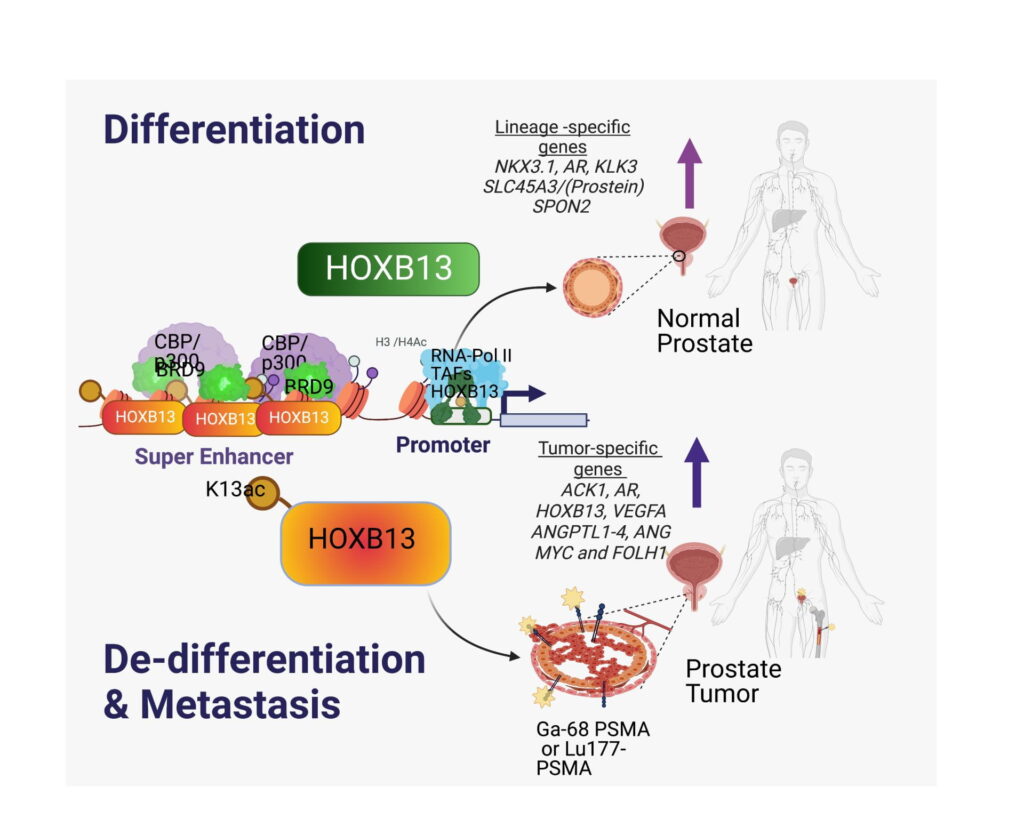
In a new finding, we uncovered a novel gain-of-function lysine (K)13 acetylation in HOXB13 mediated by the histone acetyl transferases, CBP/p300. By employing acK13-HOXB13 ChIPs in matched human normal and prostate tumors, we identified ‘tumor-specific SEs’, including SEs at the ACK1 and FOLH1 (PSMA) genes, which code for actionable targets. Thus, ‘acK13-HOXB13’ and ‘tumor-specific SE regulated genes’ are clinically relevant biomarkers to screen lethal PCs. Targeting prostate cancers expressing Super Enhancer-regulated genes at onset may be the key to preventing the development of CRPC in men diagnosed with the disease.
Nguyen D#, Yang W#, Renganathan A, Weimholt C, Angappulige DH, Nguyen T, Sprung R, Andriole GL, Kim EH, Mahajan N, Mahajan K#* Acetylated HOXB13 Regulated Super Enhancer Genes Define Therapeutic Vulnerabilities of Castration-Resistant Prostate Cancer. Clinical Cancer Research, July 18, 2022, PMID: 35849143DOI: 10.1158/1078-0432.CCR-21-3603.
We demonstrate that HOXB13 correlates with PSMA expression and PSMA PET SUVs at the mRNA and protein levels. Our study suggests that the PSMA PET findings may reflect oncogenic HOXB13 transcriptional activity in PC, thus potentially serving as an imaging biomarker for more aggressive disease.
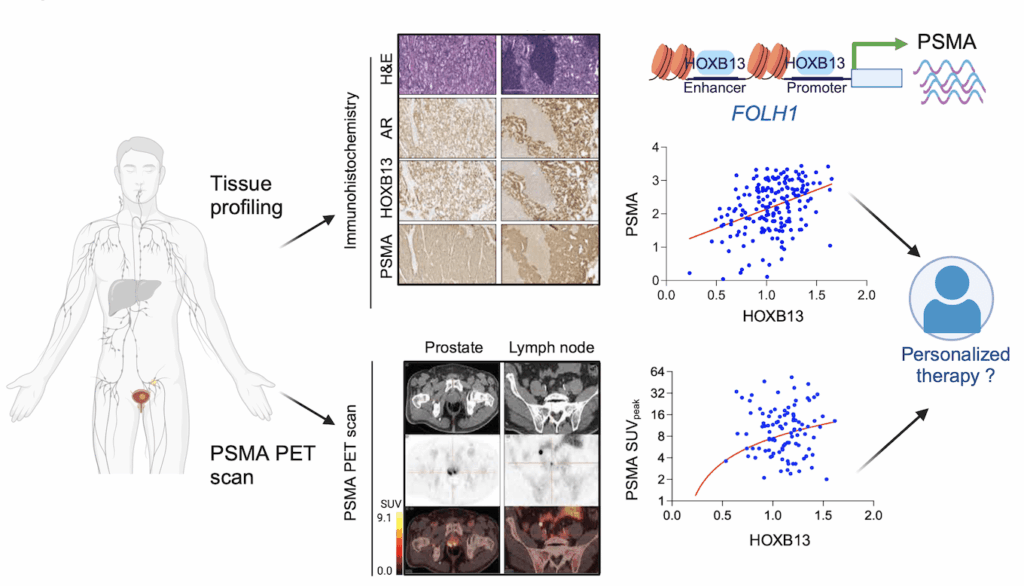
Angappulige DH, Barashi NS, Pickersgill N, Weimholt C, Luo J, Shadmani G, Tarcha Z, Rayamajhi S, Mahajan NP, Andriole GL, Siegel BA, Kim EH, and Mahajan K* Prostate-Specific Membrane Antigen-Targeted Imaging and its Correlation with HOXB13 Expression. Journal of Nuclear Medicine, 2024 . jnumed.123.267301;
We developed (R)-9b, a small molecule inhibitor that targets ACK1, a tyrosine kinase that is significantly upregulated in castration-resistant prostate cancer. By phosphorylating histone H4 at tyrosine 88, it regulates Androgen receptor transcription and promotes Enzalutamide and abiraterone-resistant prostate cancer growth. Our research revealed that AR is modified at lysine 609, located in the DNA binding domain (DBD), in Enzalutamide treated cells. Through its control of AR phosphorylation at Y267, ACK1 regulates AR acetylation at K609. Our studies reveal that ACK1 plays an important role in the development of prostate cancer drug resistance.
Mahajan K, Malla P, et. al., ACK1/TNK2 Regulates Histone H4 Tyr88- phosphorylation and AR Gene Expression in Castration-Resistant Prostate Cancer. PMID: 28609657 Cancer Cell, Jun 12;31(6):790-803. 2017.
Sawant M, Mahajan K, et. al., Chronologically Modified Androgen Receptor in Recurrent Castration Resistant Prostate Cancer and its therapeutic Targeting., Science Translational Medicine, 2022, Jun 15;14(649):eabg4132. PubMed PMID: 35704598.
Sridaran, D., Chouhan, S., Mahajan, K.# et al. Inhibiting ACK1-mediated phosphorylation of C-terminal Src kinase counteracts prostate cancer immune checkpoint blockade resistance. Nat Commun 13, 6929 (2022). https://doi.org/10.1038/s41467-022-34724-5
Recently, the contribution of long noncoding RNAs (lncRNAs) in the pathogenesis of prostate cancers has acquired prominence as they are known to epigenetically regulate the function of critical tumor promoting transcription factors. Bishop et al have reported upregulation of PD-L1 in dendritic cells in Enzalutamide resistant patients and in pre-clinical models of ENZ resistance. It is unclear whether specific factors aberrantly expressed in CRPCs simultaneously modulate castration resistance as well as immune regulation to promote lethal disease. Recently, reports indicate that that BET-bromodomain epigenetically regulate PD-L1 expression in ovarian cancers. BET inhibition with the prototype inhibitor JQ1 promotes anti-tumor immunity by downregulating PD-L1 expression in both immune cells and ovarian tumor cells, and in addition increases CD8+cytotoxic T cell activity to limit ovarian tumor progression in syngeneic mouse models. We are characterizing several new long non-coding RNAs for their roles in immune regulation.
Mahajan K* and Mahajan NP. Cross talk of Tyrosine Kinases with the DNA Damage Signaling Pathways. Nucleic Acids Research, 43(22):10588-601, 2015.

Patents
Filed Date: February 8, 2010
Issue Date: October 15, 2013
pTyr176-AKT antibody (Hybridomas) is patented by Moffitt and has been licensed for commercial Cancer diagnostic kit
Title: Antibodies specific for phosphorylated histones and uses thereof
Patent No. 9,594,084 Filed Date: July 2, 2014 Issue Date: March 14, 2017
Issue Date: April 4, 2018
Published in the European Patent Bulletin No. 18/14
pHistone antibodies have also been licensed for commercialization
Filing Date: September 23, 2014
14833894.0 (European); 201480054401.3 (China); 201637004441 (India)
Filing Date: August 6, 2014
Issue Date: December 26, 2017
This technology has been licensed
Application # 15/748,214; 62/200,084; 62/299,178
Filing Date: August 2, 2016
Our team
Kiran Mahajan, MSc, PhD
Associate Professor of Surgery
Chief, Section of Surgical Therapeutics
Division of Surgical Sciences
Division of Urologic Surgery
- Phone: 314-273-7728
Staff
Jammi Prasanthi Sirasani, MSc, PhD
Jammi Prasanthi is developing new tools to decipher HOXB13 function in lethal prostate cancer progression. Using bioinformatics, computational tools, genetically engineered mouse models of prostate cancer, Jammi Prasanthi is make significant progress in elucidating the function of HOXB13 in prostate cancer and developing novel therapies.
Aashna Doshi
Rising Junior: Pre-med Student
University of Washington Seattle
Double majoring in Biochemistry and Economics
Aashna is a very dedicated, talented researcher and a budding scientist. She has unraveled key mysteries of the HOXB13 universe and made significant strides this summer.
Collaborator: Jiqiang Yao, PhD
Photo gallery

Lab alumni
Duminduni Yashoda
PhD Student at Texas A&M
Hobbies: Music, cricket and spicy food.
Dumi has published several impactful papers from the lab.