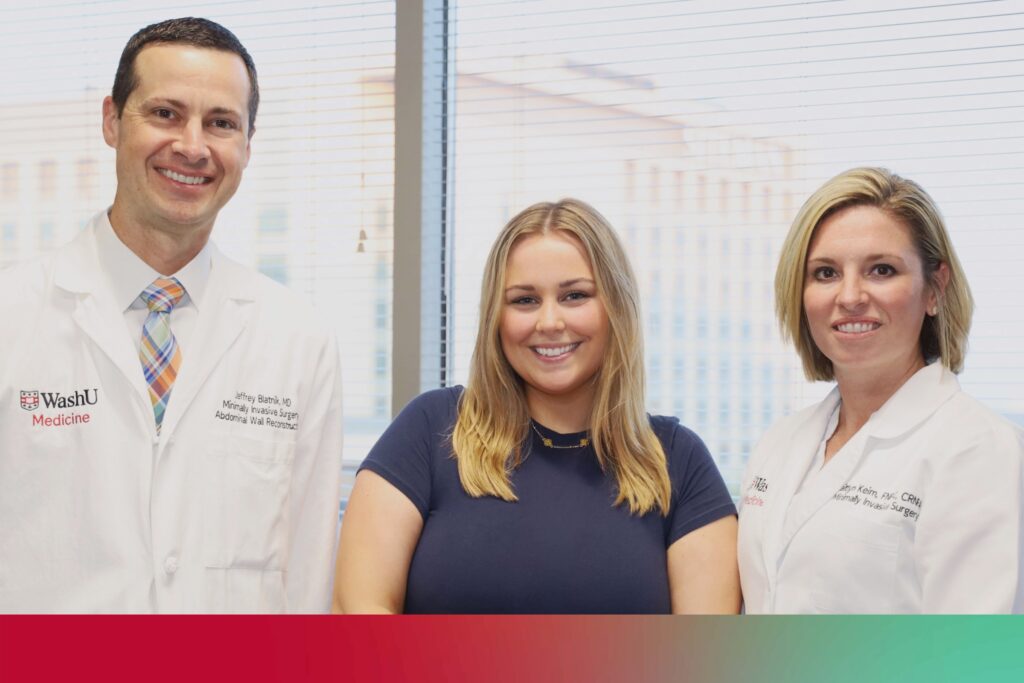
Emily Smith spends much of her workday helping tell stories about WashU Medicine physicians, nurses, care teams and patients.
As a graphic designer and social media coordinator in the marketing and communications office for the Department of Surgery, she is used to highlighting the skill, compassion and expertise behind surgical care. But in March 2026, at age 26, Smith found herself in an unfamiliar role: the patient.
Her symptoms began suddenly. She woke up in the middle of the night with intense pain in her back and abdomen. Unsure of what was happening, she did what many patients do when symptoms feel alarming: she searched online.
“I thought I had pancreatitis from googling too much,” Smith said.
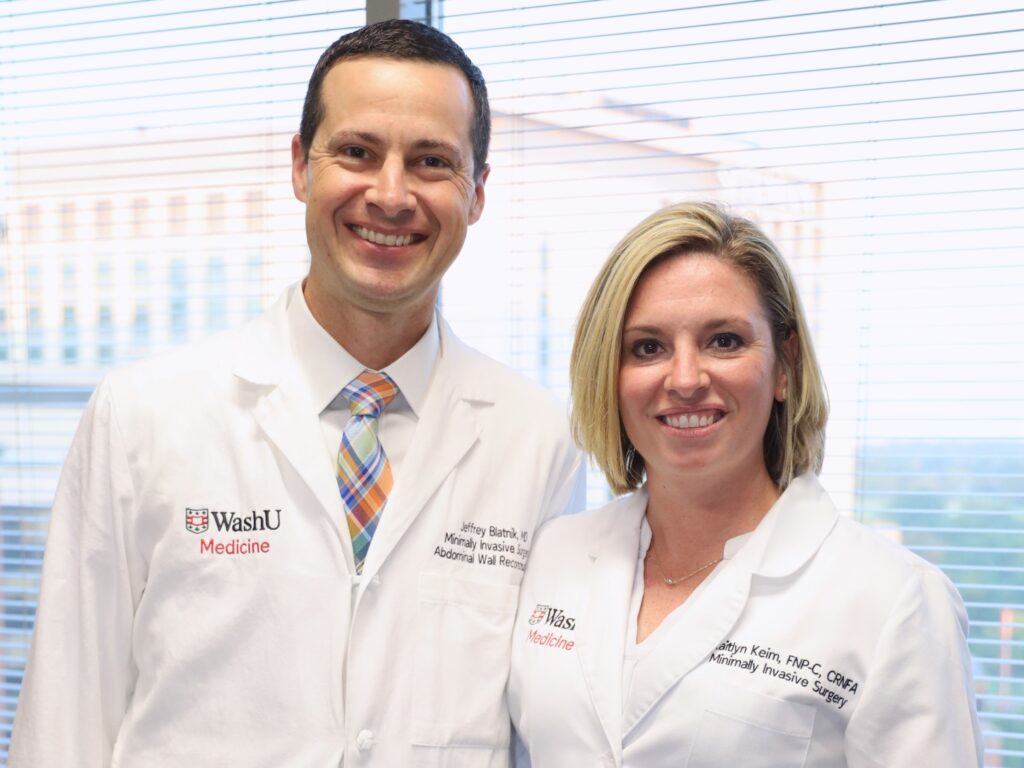
The pain eventually brought her to the emergency department, where she learned she had gallstones. From there, her care moved quickly. That same day, Smith went from the ER to an appointment with Jeffrey Blatnik, MD, director of the Division of Minimally Invasive Surgery and professor of surgery at WashU Medicine, and Kaitlyn Keim, MSN, FNP-C, CRNFA, a nurse practitioner with the Division of Minimally Invasive Surgery.
Additional imaging was ordered, and the team began planning next steps, even reserving operating room time if surgery was needed. Although gallstones had been identified, the stones were small, leaving Smith uncertain whether they were truly causing her symptoms.
“My biggest worry was that it might not actually be my gallbladder causing the problem,” Smith said. “The stones were so small that it was hard to get a definitive answer, and I was nervous about going through surgery and finding out that wasn’t the issue.”
About two weeks after her ER visit, Smith underwent robotic cholecystectomy, a minimally invasive procedure to remove the gallbladder.
Although gallbladder removal is one of the most common operations performed in the United States, it was Smith’s first abdominal surgery.
“I had my wisdom teeth and tonsils removed before, but this was my first abdominal surgery,” she said. “I was very nervous that morning.”
Trusting the team she already knew
Working at WashU Medicine, Smith was already familiar with the reputation of Blatnik and his team, which helped ease some of her anxiety before surgery.
“As an employee at WashU Medicine, I spend a lot of time telling stories about the exceptional care our teams provide,” Smith said. “Becoming a patient gave me a completely different perspective. I knew Dr. Blatnik and his team had outstanding reputations, so there was a level of trust that allowed me to focus on getting better instead of second-guessing every decision.”
For Blatnik, caring for a fellow WashU Medicine employee is meaningful, but the standard of care remains the same.
“It is a tremendous honor to be able to care for our peers and colleagues in the School of Medicine,” Blatnik said. “That being said, I feel like we take care of everyone as if they were a family member, loved one or work partner.”
At the same time, Smith said it was sometimes difficult to separate her role as an employee from her experience as a patient.
“It definitely felt strange being on the receiving end of care instead of helping promote it through my work,” she said.
Support before, during and after surgery
For Smith, some of the most meaningful parts of her experience came from the communication and reassurance she received throughout the process.
After surgery, she woke up more uncomfortable than she expected and felt anxious. Her nurse checked on her frequently, helped manage her pain and reassured her throughout recovery.
Keim explains that remaining a consistent point of contact from preparation through recovery helps patients and families feel supported and understood.
“Continuity of care is the framework for which we developed my role as nurse practitioner with the Division of Minimally Invasive Surgery,” said Keim. “Being a consistent provider throughout the perioperative journey builds trust with the patient and their family and results in a stronger patient-provider relationship.”
For Smith, the communication and support from her care team helped her feel prepared and supported throughout the process.
“I felt supported by the entire care team, from my surgeon and nurse practitioner to the nurses who cared for me on surgery day,” Smith said. “Their communication, reassurance and willingness to answer questions helped me stay calm throughout the process.”
A harder recovery than expected
Smith’s recovery was more difficult than she anticipated. Simple movements such as sitting up or getting out of bed were challenging, and for more than a week, she could not get out of bed on her own.
“It was a lot more painful than I expected,” said Smith. “Icing my incisions was my best friend.”
She began feeling herself again after a few weeks, but the experience gave her a greater appreciation for the challenges patients face during recovery.
“Experiencing it firsthand gave me a greater appreciation for the trust patients place in their care teams every day,” said Smith.
Smith also credits her family with helping her through recovery. Her mother was by her side on surgery day, and her younger sister visited daily during the first two weeks after surgery, helping with meals, getting dressed and making sure she got up and walked each day.
“Those small acts made a huge difference during recovery,” Smith said. “Having their support made an overwhelming experience feel much more manageable.”
She also appreciated the support her manager, Ken Wamsley, who helped connect her with the right care team and made sure she felt supported throughout the process.
A new view from the other side of care
For Smith, the experience did not necessarily change the way she views patient stories, but it made the work feel more personal.
She had spent years helping share stories about patients and care teams. This time, she was the person placing her trust in the team, asking questions, managing anxiety and relying on others during recovery.
“Experiencing the care, communication and support that I often help highlight in stories and social media content gave me a deeper appreciation for the real people behind those stories,” Smith said. It reinforced that the work we do ultimately reflects moments that matter deeply to patients and their families.”
Looking back, Smith said the experience was a reminder that while a procedure may be routine for a surgical team, it can be one of the most significant moments in a patient’s life. For her, the expertise mattered, but so did the responsiveness, reassurance and support she received throughout the journey from diagnosis to recovery.